

Tubing and sections
We supply tubing and rolled sections for fabrication, support frames, gates, bracing and general steelwork. From Germiston we serve Gauteng and project sites across South Africa with practical cut to requirement supply.
What tubing and sections are used for
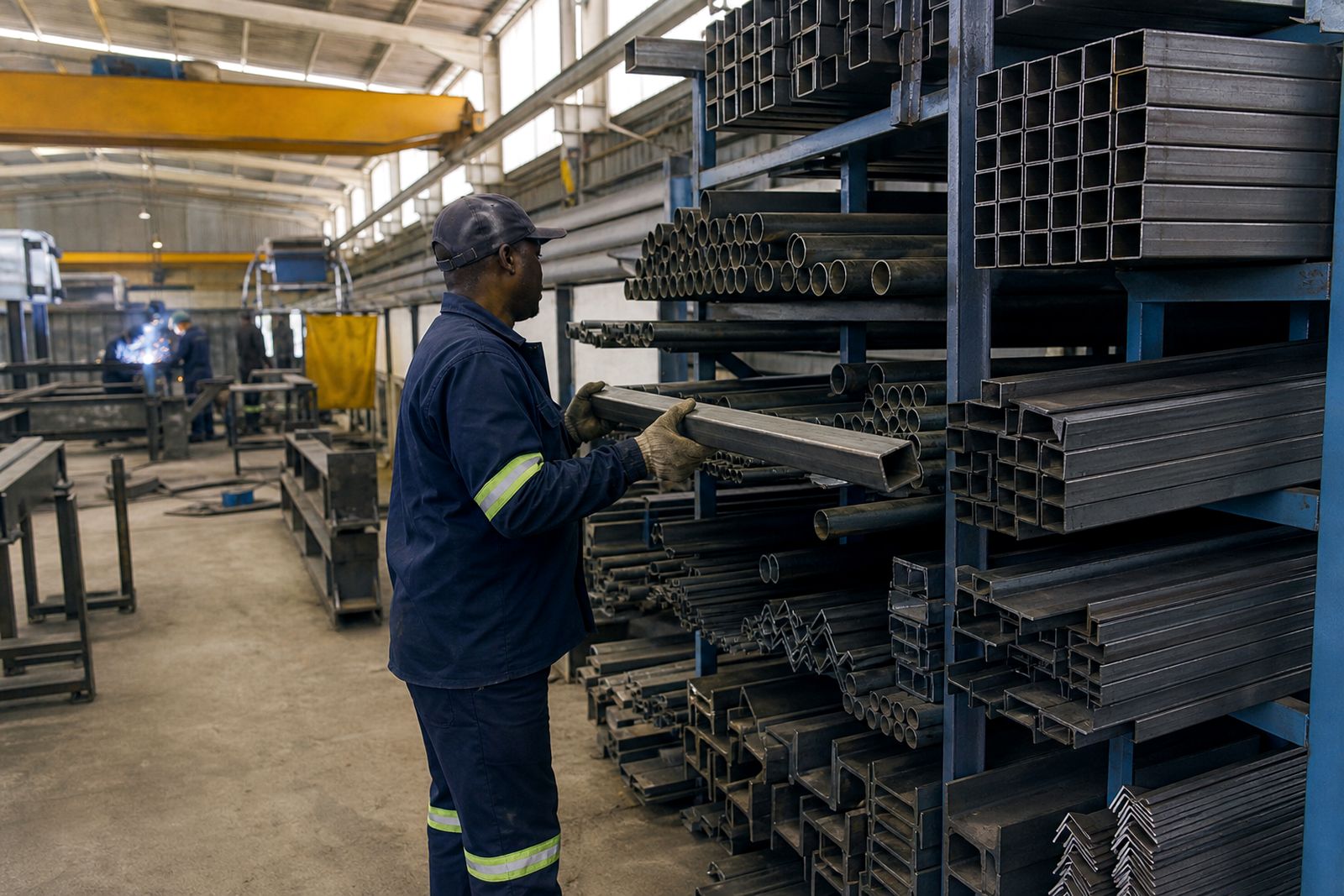
Tubing and sections are everyday steel items used where a job needs straight lengths, repeatable sizes and dependable load paths. On building work they are commonly used for frames, purlin support, bracing members, handrails, gates, protective barriers, small canopies, equipment stands and general workshop fabrication. They also suit repair work on existing structures where a full beam section is not required.
We supply common mild steel tubing and sections for industrial, commercial and agricultural use. This includes round tube, square tube, rectangular tube, equal angle, unequal angle and lip channel. Material can be supplied in full lengths or cut to size where required, which helps reduce site cutting time and waste. If a job needs welded assemblies rather than loose lengths, our fabrication team can also prepare components to drawing.
Available forms and typical size ranges
Stock and availability can vary by section and thickness, so the best approach is to send your required sizes and quantities with your enquiry. For planning purposes, these are the section types most often requested for fabrication and building support work.
- Round tube: commonly used for railings, posts, sleeves, light frames and agricultural work.
- Square and rectangular tube: suited to frames, gates, support legs, infill framing, equipment bases and neat exposed steelwork.
- Equal and unequal angle: often used for cleats, edge framing, light lintel work, brackets, trusses, stiffeners and shelving supports.
- Lip channel: a practical option for light roof and wall support members, framing rails and secondary steelwork.
Typical wall thicknesses start from light gauge sections for non critical fabrication and go up to heavier wall sections for structural support and impact resistance. Lengths are generally supplied in standard mill lengths, then cut as needed. If you need pieces drilled, welded into frames, or prepared for bolting, tell us that upfront so we can quote the right scope, not just loose steel.
Working limits and where each section suits best
These products are useful, but they are not interchangeable. Correct section choice depends on span, point loads, fixing method, wind exposure and whether the steel is part of a primary structure or only secondary framing. Square and rectangular tubing give a clean finish and resist twisting better than flat members, which makes them a good choice for gates, frames and posts. Angle iron is economical and easy to connect, but single angles can twist under load if they are not properly restrained. Lip channel works well for lighter support members, yet it is not always the right choice for long unsupported spans or heavy roof loads.
Where a member carries roof loads, suspended equipment, heavy walling or repeated vibration, section selection should be checked against the actual duty. For example, a light wall tube may suit a handrail frame but not a vehicle barrier. A small lip channel may suit side cladding rails but not a long purlin run in a windy open area. Coastal humidity, corrosive process areas and mining conditions can also change what is suitable, because steel loss over time affects capacity.
- Best suited to: frames, rails, light support members, gates, bracing, trims, platform guards and fabricated assemblies.
- Usually not suited to: long beam spans, major column loads, crane support work, badly corroded environments without proper protection, or any application where section size has been guessed.
- Check carefully for: cantilevers, dynamic loads, vehicle impact zones and exposed agricultural sites with high wind.
Site, installation and fabrication requirements
Loose lengths are only part of the job. Before ordering, think about how the sections will be moved, lifted, drilled, welded and fixed on site. Even smaller sections can be awkward in long lengths, especially in busy factory yards or on farm roads after rain. If material is being collected, confirm vehicle length and tie down arrangements. If sections are being installed inside an operating building, note any access restrictions, overhead services and times when hot work is allowed.
For bolted work, provide hole sizes, edge distances and connection plate details. For welded work, advise whether the steel will be site welded or workshop welded, because this affects fit up and coating sequence. If members are going into masonry, concrete, blockwork or existing structural steel, tell us the substrate and anchor method required. On roof related work, include the sheeting profile, purlin spacing and any municipal or engineer requirements where applicable. A lot of delays happen because a section size was right, but the fixing detail was not.
Care, storage and corrosion protection
Mild steel sections should be kept dry, off the ground and separated so water does not sit between lengths. If material is stored on a site through a wet Gauteng thunderstorm cycle or in coastal air, flash rust can appear quickly. That does not always ruin the steel, but it does mean extra preparation before painting or welding. Sections intended for visible finished work should be handled more carefully to avoid deep scratches, weld spatter and grinding marks.
- Store bundles on timber packers, not directly on soil or concrete.
- Cover from rain while still allowing airflow to prevent trapped condensation.
- Prime or paint after proper surface preparation if the steel will be exposed.
- In corrosive areas, ask about a coating plan suitable for the site conditions.
- Inspect cut ends, drilled areas and weld zones, because these often rust first.
If the material is for food processing areas, chemical plants or coastal sites, mention that early. The right protection system depends on the environment and the expected service life not just the section size.
What to send with your enquiry
The quickest way to get the right supply is to send a clear list from the start. We do not publish prices on this page because section size, thickness, cutting and fabrication all change the quote. Use the contact page enquiry form and include as much detail as you can.
- Section type, for example round tube, square tube, angle or lip channel.
- Outside size and wall thickness, or a drawing if you have one.
- Length per piece and total quantity required.
- Whether you need full lengths, cut pieces, drilled pieces or welded assemblies.
- Project location in Germiston, Gauteng or elsewhere in South Africa.
- Use case, such as gate frame, roof support, bracing, handrail or agricultural structure.
- Required finish, if any, and whether the steel will be indoors, outdoors or in a corrosive area.
- Collection or delivery preference and any site access limits.
If the sections form part of a structural building element, send the engineer's drawing or member schedule. That saves back and forth and helps avoid ordering steel that looks right on paper but is too light for the job.
What our Steel Structures customers say
Verified Google reviews
Questions we get asked
Can you cut tubing and sections to my required lengths?
Yes. If you send a cut list with section sizes, piece lengths and quantities, we can quote supply in cut lengths where appropriate.
Are lip channels suitable for all roof support work?
No. Lip channel is often used for lighter secondary framing, but the correct size depends on span, spacing, wind and roof load. For structural roof members, send the design requirements or drawings.
Do you supply only to Germiston?
No. We are based in Germiston and supply Gauteng regularly, with project supply and fabrication support for work across South Africa.
Also worth a look
Ask for a quote
Send your building type or steel requirement, approximate dimensions and project town through the form, and the team can respond with a quote for supply, fabrication or erection.
Open the contact form