

Flat, round and square bar
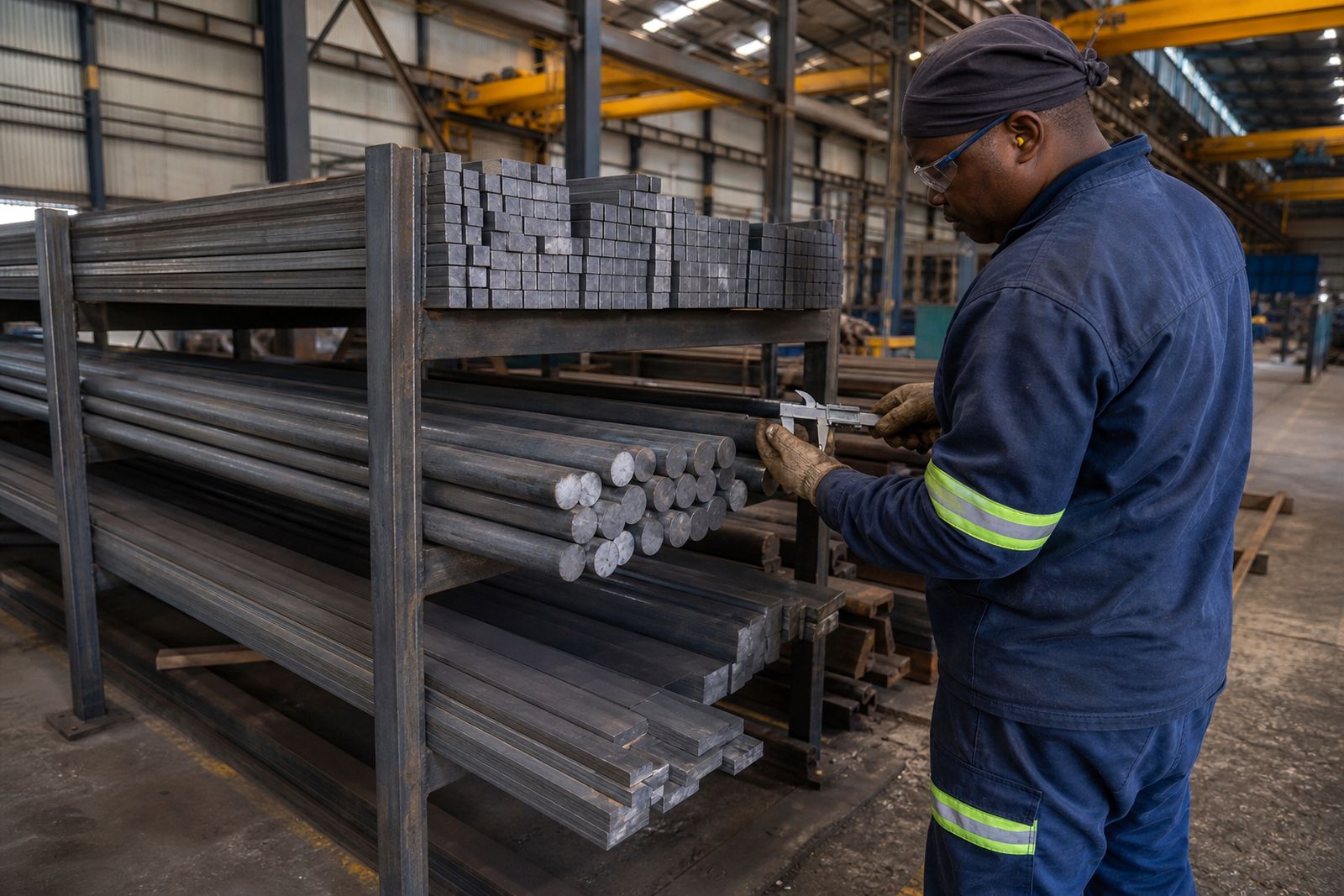
We supply mild steel flat bar, round bar and square bar for fabrication, repairs and everyday steelwork from Germiston. Stock is available for public sales and trade orders, with cutting to requirement where suitable for handling and transport.
What flat, round and square bar is used for
Bar stock is one of the most useful steel products in a fabrication shop. Flat bar is commonly used for cleats, base plates, straps, bracing details, frames, gate work and patch repairs. Round bar suits pins, tie rods, handles, guards, anchors and formed items. Square bar is often chosen for forged style gates, burglar proofing, small frames and general workshop jobs where a solid section is needed.
For contractors, farmers and maintenance teams, these sections are practical because they are easy to cut, drill, weld and fit on site. They also work well with other steel products such as angle, tubing, channel and sheeting. If you need steel that can take a bend, weld into a bracket, or be machined down for a specific fit, bar stock is usually the starting point.
Available forms and typical size range
We supply mild steel bar stock in standard mill lengths, with cut lengths where required for transport or fabrication. Exact stock changes with demand, so it is best to confirm the section and quantity you need when sending your enquiry. If you need repeated cut pieces for workshop use we can discuss practical cutting tolerances and bundle quantities.
- Flat bar: commonly specified by width x thickness, for example 25 x 3 mm, 40 x 6 mm, 50 x 10 mm and larger sections for plates, cleats and stiffeners.
- Round bar: commonly specified by diameter, such as 6 mm, 12 mm, 16 mm, 20 mm and heavier diameters for pins, tie members and machined items.
- Square bar: commonly specified by side size, such as 10 mm, 12 mm, 16 mm and heavier sections for gates, grills and solid frame details.
- Supply format: full lengths or cut pieces, depending on handling, transport and the intended job.
Smaller sections are easier to work by hand on site, while heavier bars quickly become difficult to lift, align and drill without proper equipment. If the material must fit into a bakkie or through a narrow factory entrance, tell us that upfront and we can advise on practical cut lengths.
Working limits and where bar stock does not suit
Bar stock is versatile, but it is not the right choice for every structural job. Flat bar works well for light to medium brackets and connection pieces, but long unsupported lengths can twist or deflect if undersized. Round bar is good in tension and for pins, yet it is not usually the first choice for beams or members that must resist bending. Square bar gives a solid look and good weld area, though it becomes heavy quite quickly for longer spans.
For main structural members in factories, warehouses, churches or sheds, rolled sections such as beams, columns, channels and tubular members are usually more suitable. For reinforced concrete work, reinforcing mesh or rebar is the correct product rather than plain round bar. If corrosion is a concern near the coast, in wash bays or in chemical process areas, surface protection and detailing matter a lot, otherwise rust can start early around cut edges and welds.
- Not ideal for long beam spans unless designed as part of a built-up section.
- Not the preferred choice for concrete reinforcement unless specified for a particular detail.
- Not suitable for exposed corrosive areas without the right protective finish.
- Not always economical for large volume structural framing where hollow sections or beams will do the job better.
Site, fabrication and installation considerations
Most bar stock is supplied for welding, bolting, drilling, bending or machining. Before ordering, think about how the material will actually be used on site or in the workshop. A 6 metre length may be standard, but if your access gate, stairwell or store area cannot take that length it will slow the job down. Likewise, heavy solid bar can be awkward to move without chain blocks, forklifts or enough labour.
If you are fitting bars into existing steelwork, old concrete, farm structures or machinery guards, accurate dimensions are important. Small errors in hole centres or pin diameters can hold up a repair. On sites affected by power cuts, many teams prefer to have steel cut and marked in advance so less workshop work is needed once the crew is on the ground.
- Confirm whether you need full lengths or cut pieces.
- Provide hole sizes, centres and edge distances if drilling is required.
- Advise whether bars will be welded, bolted or machined.
- Check access for delivery vehicles and offloading equipment.
- Tell us if the steel is for coastal, mining, agricultural or high moisture conditions.
Care, storage and finishing
Mild steel bar should be stored off the ground on level bearers and kept as dry as practical. Surface rust can form quickly in humid conditions, especially in coastal towns and in open yards after rain. That is normal for untreated steel, but heavy contamination, standing water and contact with mud should be avoided because cleaning takes time and can affect paint adhesion.
Where the steel will remain exposed, it should be properly prepared and coated after cutting and welding. Edges, holes and weld areas need attention first because that is where corrosion often starts. If bars are being built into gates, platforms, supports or external frames, ask about a suitable finishing approach for your environment. Farm use, fertiliser exposure and industrial fumes all need more care than dry indoor work, and a quick coat on dirty steel never lasts long.
What to send with your enquiry
A clear enquiry helps us supply the right material the first time. If you already have a sketch, cutting list or fabrication drawing, include it. If not, a simple list with sizes, quantities and intended use is enough to start. For larger orders or repeated production work, it helps to group each item by section type and length.
- Section type: flat bar, round bar or square bar.
- Size: width and thickness, diameter, or square size in millimetres.
- Length per piece and total quantity required.
- Whether you need full lengths, cut lengths, drilled pieces or fabrication.
- Application: gate work, repairs, brackets, machinery, agricultural use or structural detail.
- Delivery town, collection preference and any site access limits.
We supply from Germiston to customers in Gauteng and across South Africa. If your order forms part of a larger steel package, we can also assist with related sections and fabrication so the job goes out in a practical sequence.
What our Steel Structures customers say
Verified Google reviews
Questions we get asked
Can you cut bar stock to my required lengths?
Yes. Let us know the exact cut lengths and quantities. For repeated pieces, include your preferred tolerance and whether pieces need to be marked or bundled.
Is plain round bar the same as reinforcing steel?
Not necessarily. Plain round bar and reinforcing products are used differently. If the steel is for concrete work, tell us that in your enquiry so we can point you to the correct product.
Can bar stock be used outdoors?
Yes, but mild steel outdoors needs proper surface preparation and a suitable protective coating. Coastal humidity, agricultural exposure and industrial moisture all shorten the life of untreated steel.
Also worth a look
Ask for a quote
Send your building type or steel requirement, approximate dimensions and project town through the form, and the team can respond with a quote for supply, fabrication or erection.
Open the contact form